Through NSPA, OSFA’s Lo Klink strengthens relationships between UW–Madison, scholarship providers
One particular memory stands out to Dr. Lauren “Lo” Klink when describing her first National Scholarship Providers Association conference eight years ago.
In a room overwhelmingly filled with representatives from foundations that award student scholarships, Klink was one of a small number of people representing an institution of higher education. And the two groups aren’t always aligned.
“I remember distinctly turning my badge over because I didn’t want them to see that I was from an institution,” she recalls. “It was very much us versus them.”
Today, Klink is the chair-elect of the association’s Board of Directors, the first person representing an institution to hold that role. That, she says, is a signal that scholarship providers and institutions are closer together than they are apart.
Bridging the gap
Institutions and foundations can operate under significantly different rules and have different priorities, but one thing unites both groups: the desire to find the best possible outcome for students.
Through NSPA, Klink has been able to have more candid discussions with foundation representatives about how to do that.
Having a seat at the table also means UW–Madison can continue to work on ways to remove barriers that could otherwise prevent students from receiving scholarships. Historically, one of those barriers has been a disconnect between scholarship providers and institution administrators.
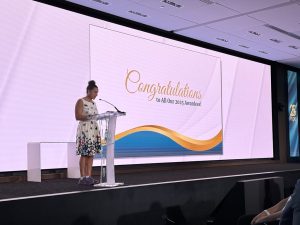
“I think that over the last eight years – and in particular probably the last three years – our ability to influence and be a part of the conversation has led to, I hope, less of those negative impacts where [foundations are] just not sending their scholarships to an institution just based on the experience that they had with an administrator, or sometimes foundations will share, ‘I can’t even get anyone on the phone, I don’t even know who to email.’ That’s not what we want to happen,” Klink says. “We want it to be a conversation. We want to be a warm handoff.”
By building direct relationships between foundations and institutions, both parties know they have someone they can turn to when they want to assess program effectiveness. That, Klink says, has been positive for not only UW–Madison, but for all NSPA member institutions.
“I think previously the door would have just been closed because [scholarship providers] wouldn’t have known who to contact or what to say or how to inquire about a scholarship not having the impact that they want it to, and now they know there are options available,” she says. “Making them aware of those options and making the students know of those options specifically for scholarship displacement has led to really positive outcomes for not just UW–Madison, but for institutions as a whole, like some institutions actually very publicly published all sorts of information on scholarship displacement and what students and foundations can do, and I’d like to think that some of that has come about because of my work with NSPA.”
Student-centered advocacy
One area of focus for NSPA is finding ways to mitigate scholarship award displacement – which occurs when a student earns a scholarship and then has other parts of their financial aid package reduced accordingly to comply with federal regulations.
NSPA is also pushing for law changes that would once again make awards used for non-tuition costs tax-free and allow students’ FAFSA data to be shared with private scholarship providers.
In addition to tackling these priorities, as chair-elect Klink will lead the Governance and Nominations Committee, which reviews and interviews board candidates, contributes to the Executive Committee, takes a leading role at the national conference, and update board committee charters as needed.
She will also be involved in shaping conversations around the use of artificial intelligence in scholarship essay writing and the practice of including letters of recommendation in applications.
Professional growth
Klink’s work with NSPA has also played a significant role in her professional growth. The insights she gained through NSPA informed both her master’s and doctoral studies, which she recently completed in 2021 and 2025, respectively.
“Joining NSPA impacted not only our campus positively, but it kind of helped to guide my future professional focus for my own education,” she says. “Both my master’s capstone and dissertation focused on scholarships as an important funding source in higher education.”
It also provided a lesson in the importance of persistence.
“I had applied for the board and I didn’t get on the first year, so I think it’s important to know that if you first don’t succeed, sometimes that wasn’t your time,” Klink says. “The very next year, the board actually reached out to me and said, ‘Hey, you had a strong application last year, we’d love to see you in the pool again this year.’ Had that not happened, I don’t think I would have [applied] because I would have just been bummed and not thinking it was for me.”
By the Numbers
- 400+: The number of scholarship administrators at UW–Madison
- ~$40 million: How much scholarship aid OSFA awards annually
- 2,500: NSPA member institutions and foundations
- ~$8 billion: How much NSPA members award annually
This article is part of a series highlighting the Division of Enrollment Management’s contributions to higher education beyond the boundaries of UW–Madison, in keeping with the Wisconsin Idea and our Strategic Framework.