IACAC and EducationUSA help OAR’s Sarah Woller introduce UW–Madison to a global audience
Growing up in a small community in central Wisconsin, Sarah Woller knew she wanted to attend a university that broadened her global perspective. Two degrees and two study abroad experiences later, the double Badger now travels the world to introduce students to the University of Wisconsin–Madison.
Woller first joined the Office of Admissions and Recruitment in 2019 and today serves as the office’s manager for international recruitment and relationships. Through her role, she works with national and international organizations to promote higher education opportunities at UW–Madison and more broadly across the United States.
As a member of the International Association for College Admissions Counseling’s (IACAC) Global Affairs Committee, Woller works to help increase geographic representation in higher education by identifying sites for IACAC regional institutes and reviewing grant opportunities to help counselors and others attend those events.
Through EducationUSA, Woller works with embassies and consulates to present about American educational opportunities while building relationships that reassure education officials that students from their countries can succeed at UW–Madison.
Supporting and recruiting students
Coming to another country for an education brings myriad challenges, from the practical (What type of visa do I need?) to the geopolitical (Does my country have a well-established relationship with the U.S.?). Fortunately, the network of support resources for international students – both on campus and via partnerships made through IACAC and EducationUSA – is broad.
“I first like to acknowledge how [prospective students are] feeling, and I always tell them about Wisconsin, all of the different opportunities, the resources,” Woller says of trying to ease students’ worries. “Being a larger institution is something that a lot of students feel really nervous about, but it’s also one of our greatest strengths in what we are able to offer our students: resources in and out of the classroom. We have a pretty robust international student population, so telling them the students that do well at Wisconsin, that make the most of their Wisconsin Experience, that get the most, are the students that are okay stepping out of their comfort zone, that are okay taking initiative, and by just virtue of these students choosing to apply to the United States, being open to a new culture, a new country, a new perspective, they’re already prepared to come here.”
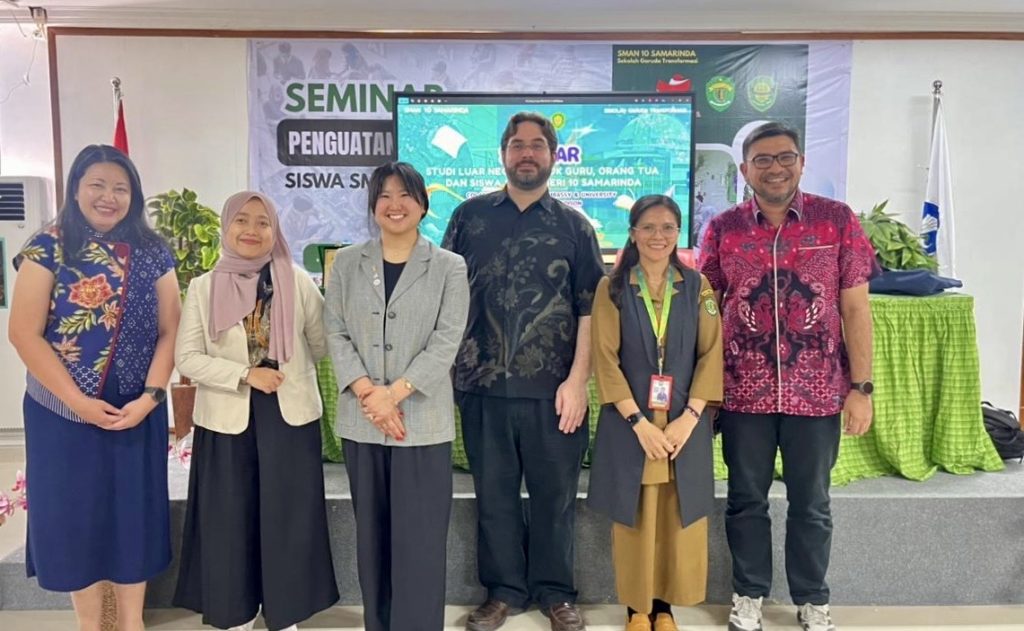
In late January and early February, Woller was invited to travel to Indonesia to speak with students from smaller regions of the country like Borneo and Bogor. Often, UW–Madison was the first U.S. institution those students had interacted with.
While there, she also met with an embassy representative and EducationUSA to talk about opportunities at UW–Madison for sponsored students – those who receive support from their governments or other organizations to study in the U.S.
The opportunity was a direct result of her work with EducationUSA.
“They knew that I worked with sponsored students, and I had developed a strong relationship and trust with Wisconsin, so when this new initiative came up, they shared, ‘We know a school that fits what the Ministry of Education in Indonesia is looking for in terms of geographics, programs, as well as this is a place that we feel comfortable and confident that our students are going to be supported in and out of the classroom, and therefore, we want you to come, we’re going to cover the cost, we want you to talk to all of these students that are in parts of the country that we would not have visited otherwise,’” Woller says.
Knowledge sharing
Both IACAC and EducationUSA prioritize swapping strategies for supporting students and sharing knowledge of everything from the evolving federal landscape to what’s happening in a student’s home country.
This collaborative partnership was crucial during the COVID-19 pandemic. With in-person events no longer possible, Woller worked with EducationUSA to create a mini-podcast on social media to answer questions that students from India had about writing admission essays.
“It was recognized as one of the most popular sessions and most useful that students felt like they were really able to get a lot from it,” she says.
As word spread about the project’s success, other EducationUSA offices and institutions began to adapt the idea for their own needs.
“Being part of organizations like International ACAC, or attending the EducationUSA Forum, or working with them, provides us the opportunity to have our perspectives challenged, to learn more, to engage with professionals, to see what peer institutions are doing, to learn about trends, patterns, but also to make connections,” Woller says. “There are so many different things that I simply would not have gotten connected to or not be aware of if I had not been part of these organizations.”
And during times of uncertainty, that’s especially important.
“One thing that has really stuck with me is just how tight the community is,” she says. “There are so many questions, so many unknowns with higher education right now, and it’s like, regardless of what’s going on, there is still so much support and belief in the power of it, that is one of those things that I think it’s just hard to put into words.”
By the Numbers
- 7,446: The number of international students enrolled at UW–Madison in Fall 2025
- 128: The number of countries that UW–Madison students call home
This article is part of a series highlighting the Division of Enrollment Management’s contributions to higher education beyond the boundaries of UW–Madison, in keeping with the Wisconsin Idea and our Strategic Framework.