From the ground up: OSFA’s Chris Lopac builds HEUG’s new Gideon Taylor eForms group
Something that struck Chris Lopac early in his career was how much higher education institutions collaborate to solve collective challenges.
“I think back to when I was in the private sector, how you would never share information or knowledge with ‘competitors’ or other peers across the industry,” he says. “When I first joined higher ed, and I started attending some of these conferences and seeing the webinars and the content that was just openly shared, it really opened my eyes to how much opportunity there is to continue learning, which makes sense, it’s higher ed – learning – but just the ability to share openly ideas and knowledge,” he said.
Over his 13 years on campus, Lopac, the assistant director for systems in the Office of Student Financial Aid, has leaned into that philosophy. He spent three years on the Higher Education User Group’s (HEUG) Campus Community Advisory Group, helping peers lead webinars and create blogs.
Then, an opportunity to build something new presented itself.
From the ground up
Lopac founded and serves as the inaugural chair of HEUG’s new Gideon Taylor (GT) eForms Advisory Group, which collaborates on solutions to streamline business processes using Gideon Taylor’s electronic form add-on for Oracle PeopleSoft.
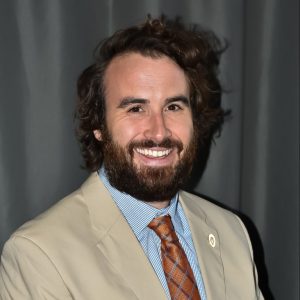
The committee was born from what Lopac calls a “perfect combination” of needs and wants from higher education professionals. Remote work environments and federal digital accessibility rule changes made the shift to high-quality electronic forms crucial. And as the higher education landscape evolves, the technology offers an opportunity to increase efficiency and improve students’ experiences when requesting emergency support or review of their eligibility for the Wisconsin Tribal Educational Promise Program.
“I mean, think about 5, 10 years ago – and I mean, shoot, it still goes on right now – there’s paper forms where students have to walk across campus to turn in or get a signature and turn in a form, and that’s absolutely crazy to think about, especially with the remote setting we’re in,” he says. “So I always think about when I’m building out a form, or I’m trying to work with others, I think about that student in February that has to walk all the way across campus in the middle of a snowstorm to turn in that paper form, and how that’s the complete opposite of being student-centric.”
Creating this group has not only increased collaboration among institutions; it has also provided more opportunities to work directly with and provide user feedback to Gideon Taylor.
And beyond the immediately visible impacts of collaboration, Lopac notes the invaluable benefits that come from establishing relationships with key partners.
“It’s not just GT-specific, I’d say. So when I’m at [HEUG’s] Alliance [conference] or just a part of this larger Higher Education User Group, I’m finding solutions for financial aid items, for querying, for campus community-type issues for GT, so it’s not just one or the other.” Lopac says. “And then it’s also you’re building a network. The one big takeaway from attending the conferences, from being a part of the advisory groups… is really that you’re networking and building these connections that you can rely on down the road, whether it’s a month from now, whether it’s five years from now. You build these connections, and sometimes those conversations are talking about things like, ‘What are you doing with Smartsheet? What are you doing with Jira?’ And… those conversations stack on top of each other to help you as a person and a team member far down the road and not just in this brief little time right now when we’re talking about a specific eForm or a specific query.”
Developing leadership
Chairing the committee has helped Lopac establish UW–Madison – and himself – as a leader while ensuring the university’s perspective is part of the conversation.
“We always want to be setting the bar, right? We want to set the standard, we want to be the best, whether it’s the best research institution, whether it’s the best at metrics regarding financial aid, whatever it might be, we want to be the leader,” he says. “So having our representation in these national settings, on these advisory groups where we’re sitting in meetings with Oracle representatives, or we’re sitting in meetings with the GT eForms, some of the main people on their team, it all continues to stack and builds credibility and helps build UW–Madison’s reputation as a leader.”
As he looks toward the second half of his three-year term leading the committee, Lopac hopes to see it continue to grow and develop strategies to succeed in the long term.
And the leadership experience he has gained can help him do that.
“It definitely has brought me out of my comfort zone, but it’s helped me find a new comfort zone and new level of confidence that I didn’t necessarily have at the national level,” he says. “Leading these different calls, leading webinars, leading these presentations, it’s really helped me bring back a whole new level of experiences to incorporate at UW–Madison.”
This article is part of a series highlighting the Division of Enrollment Management’s contributions to higher education beyond the boundaries of UW–Madison, in keeping with the Wisconsin Idea and our Strategic Framework.