OAR’s Blaine Harvey connects global communities with IACAC
Early in his time with the Office of Admissions and Recruitment, Blaine Harvey knew he wanted to expand his skillset while contributing to the broader world of college admissions.
That’s a goal quite fitting for someone whose role is an admissions counselor for global initiatives.
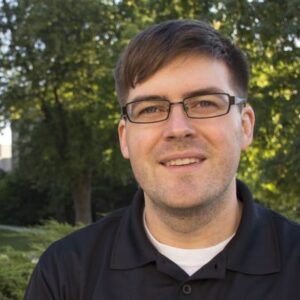
So in 2025, Harvey began a three-year term on the International Association for College Admission Counseling’s (IACAC) Communications Committee. In that role, he and nearly two dozen peers from across the globe help boost engagement with the organization and among IACAC members.
Making connecting easier
As a committee member, Harvey takes an active role in building bridges between admissions counselors, high school counselors, and IACAC.
With a network spanning the globe, creating opportunities for connection can be challenging. It was with that in mind that Harvey and his fellow committee members built a webpage listing counselor networks geographically as well as ways to get in touch with counselors in an area – whether via an email group, a Facebook group, or a WhatsApp group.
“If you wanted to see for Hong Kong, they have a Facebook group, they also have a private email list, and then they have the contact information for the people and then you can find them through our member directory,” Harvey explains. “It’s super simple stuff, but it really just helps people who are transitioning, or who are new, or counselors that want to connect in the region.”
Whether simple or complex, projects like this can have a tremendous impact when it comes to growing professional networks.
Building new skills
Before joining the OAR team four years ago, Harvey spent five years as an academic advisor in the College of Letters & Science and the Center for Academic Excellence. Earlier in his career, he spent three years teaching in rural Japan. Each of those roles required strong communication skills; on the committee, he is honing them further through communication project identification and management while learning new platforms like WordPress.
In the future, Harvey says he would also be interested in learning more and taking on some social media-related communication efforts.
That variety from his normal duties is something he welcomes.
“I’m the type of person that’s very reflective, I like to process and take time, and so sometimes I think it’s hard for me to jump in and volunteer right away, and so I think being on a committee and when there are opportunities to jump in and do something a little bit extra, that’s good for me professionally, because I might have a tendency to sit back and maybe wait too long to jump in,” he says. “So I think it’s pushing me, as cliche as it is, out of your comfort zone, but to try some new things and work on some projects that I might not be doing normally.”
Harvey strives to be an active contributor to the committee’s work, but that can be a challenge with such a large group. Ultimately, he says, members get out of it what they put in.
“I think you have to be really intentional with your time, because if you don’t, I think the committee is just a meeting that you come to, so I think you have to really think about when you’re joining committees, what do you want to get out of it? What do you really want to do? And then try to take advantage of the time that’s available to you,” he says. “Otherwise, it’ll just end up being something that you go to and you check off at the end of the day, and I don’t want it to be like that for me or for anybody that does committee work. I think it should move us forward in some sense.”
Bringing it home
Serving on the committee has given Harvey more insights into the broader higher education landscape and shown him how other institutions are handling the challenges facing the industry. Those are lessons he can share with colleagues here at UW–Madison.
“I feel like the work we do on campus, it’s very specific, and we work within our team, and so there’s not a lot of other people doing that type of work per se, and so it’s really good then to be able to connect with the broader world, in that sense,” he says.
This article is part of a series highlighting the Division of Enrollment Management’s contributions to higher education beyond the boundaries of UW–Madison, in keeping with the Wisconsin Idea and our Strategic Framework.